Malware Analysis Report: Sample 2 (UPX-Packed C2 Beacon)
Sample 2 (UPX-Packed C2 Beacon)
Cyber Security Incident Response Team: Luis G. Rojas Ortiz
Date: 4/28/2026
The following analysis was conducted as part of a structured malware analysis exercise. Sample artifacts were provided as part of a simulated incident response scenario.
Executive Summary
Static analysis of Sample 2 was limited due to UPX packing with tampered headers, which prevented successful automated unpacking and obscured key characteristics of the binary. Despite this, behavioral analysis revealed that the sample exhibits network beaconing activity consistent with other samples in the same campaign (e.g., Sample 1 and Lab03).
Dynamic analysis confirmed outbound HTTP communication to known domains and registry modifications related to Internet Settings. Overall, the malware appears to function as a lightweight command-and-control (C2) beacon that relies on runtime obfuscation techniques to evade detection.
Case Details
| Field | Value |
|---|---|
| Date | 4/28/2026 |
| Analyst | Luis G. Rojas Ortiz |
File Information
| Field | Value |
|---|---|
| File name | Sample 2.exe |
| File size | 14336 bytes |
| File type | Application/Executable (.exe) |
| MD5 | 6C2A33512B8B0EC906982783E82B9678 |
| SHA1 | ABE778CA6D429DD7CD21AB2FBD226F421390050D |
| SHA256 | 212B29A8E36CCC8F65205122E33D84940A156A9A91329F747A713F988A157948 |
| Packer / Compiler | UPX (tampered headers) |
| Compile time | Wed Nov 09 00:03:23 2011 |
Case Specific Requirements
Malware analysis was initiated after suspicious process activity was detected on a Windows endpoint during routine monitoring. The sample was recovered from a quarantined host flagged by antivirus. The sample is linked to the same malware campaign as Sample 1 and Lab03. It uses similar command-and-control (C2) infrastructure, beaconing behavior, and registry interactions. Although the malware is UPX packed and includes anti-analysis modifications, its network communication patterns remain consistent with previously observed samples, indicating reuse of attacker tooling with minor obfuscation changes.
Analysis
The malware functions as an HTTP-based beacon that communicates with a remote command-and-control (C2) server. It dynamically resolves API functions through LoadLibrary and GetProcAddress, constructs URLs at runtime, and uses WinINet APIs such as InternetOpenA to establish outbound network connections. The sample also modifies HKCU\Software\Microsoft\Windows\CurrentVersion\Internet Settings\ZoneMap\*, indicating attempts to alter Internet security settings or influence network communication behavior.
Indicators of Compromise (IOCs):
- Domains:
canonicalizer.ucsuri.tcs,www.practicalmalwareanalysis.com - Registry:
HKCU\Software\Microsoft\Windows\CurrentVersion\Internet Settings\ZoneMap\* - File:
Sample 2.exe - Behavioral: Dynamic API resolution (
LoadLibrary,GetProcAddress), WinINet usage (InternetOpenA), UPX packing with modified headers
Persistence: No persistence mechanisms were identified. The malware does not create run keys, services, or scheduled tasks and appears to rely solely on user execution.
CVE / Vulnerability: No software vulnerability or CVE was observed. The malware requires user execution rather than exploiting a specific application or service.
Static Analysis: Static analysis was significantly limited by UPX packing with tampered headers, which prevented automated unpacking via standard tooling and obscured the true import table and string contents. Detect It Easy identified the packer signature as UPX, and entropy analysis confirmed this with an overall score of 7.50 bits/byte at 93% packed, consistent with compressed or encrypted content. The binary presents only six visible imports: LoadLibraryA, GetProcAddress, VirtualProtect, VirtualAlloc, VirtualFree, and ExitProcess from kernel32.dll, alongside InternetOpenA from wininet.dll and a single ws2_32.dll function loaded by ordinal rather than name — a deliberate obfuscation technique. The LoadLibrary and GetProcAddress combination indicates the malware resolves its true API calls at runtime, hiding its full capability from static analysis. The string http://%s suggests dynamic URL construction at runtime. Structural anomalies include a custom section named LOL0, an entry point located outside the first section, and a writable first section — all consistent with a modified UPX stub designed to resist analysis tools.
Remediation
- Isolate the affected host immediately to prevent further C2 communication to
canonicalizer.ucsuri.tcsandpracticalmalwareanalysis.com. - Block associated domains at the perimeter firewall and proxy. Note:
canonicalizer.ucsuri.tcsis shared across all three analyzed samples — a single block disrupts the broader campaign. - Remove
Sample 2.exefrom disk and scan for additional copies using the provided file hashes. - Inspect and restore modified Internet Settings ZoneMap registry keys to their default values.
- Review network logs for outbound HTTP beaconing activity and investigate additional hosts exhibiting similar communication patterns.
Additional Information / Examiner Notes
PE header analysis suggests DEP/ASLR may not be enabled, though results may be unreliable due to packing and header tampering. Observed repeated modifications to ZoneMap-related registry keys suggest potential manipulation of browser security zones or proxy handling, possibly to facilitate outbound communication or evade network restrictions. High entropy (7.622) supports the presence of packing/obfuscation. Custom section name observed: LOL0. Entry point located outside the first section, indicating abnormal structure. The similarities between this sample and previously analyzed malware suggest a shared campaign or toolkit. Further analysis, including manual unpacking or debugging, may reveal additional capabilities that were not observable during this analysis.
Network Indicators
canonicalizer.ucsuri.tcswww.practicalmalwareanalysis.com
File Indicators
| Hash | Value |
|---|---|
| MD5 | 6C2A33512B8B0EC906982783E82B9678 |
| SHA1 | ABE778CA6D429DD7CD21AB2FBD226F421390050D |
| SHA256 | 212B29A8E36CCC8F65205122E33D84940A156A9A91329F747A713F988A157948 |
Registry Indicators
HKCU\Software\Microsoft\Windows\CurrentVersion\Internet Settings\ZoneMap\ProxyBypassHKCU\...\ZoneMap\IntranetNameHKCU\...\ZoneMap\UNCAsIntranetHKCU\...\ZoneMap\AutoDetect
Behavioral Indicators
- UPX packed with tampered headers
- Dynamic API resolution at runtime
- Outbound HTTP beaconing on execution
Attachments

Figure 1: FakeNet-NG captured DNS resolution requests for canonicalizer.ucsuri.tcs and www.practicalmalwareanalysis.com on execution, confirming active C2 beaconing behavior. fs.microsoft.com is attributed to Windows background activity and is not considered a malware IOC.
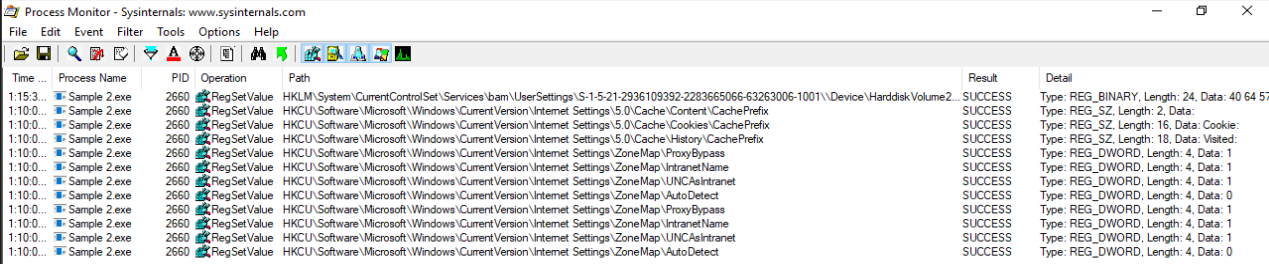
Figure 2: Procmon captured RegSetValue operations by Sample 2.exe modifying Internet Settings ZoneMap keys, consistent with behavior observed across all three samples in this campaign.
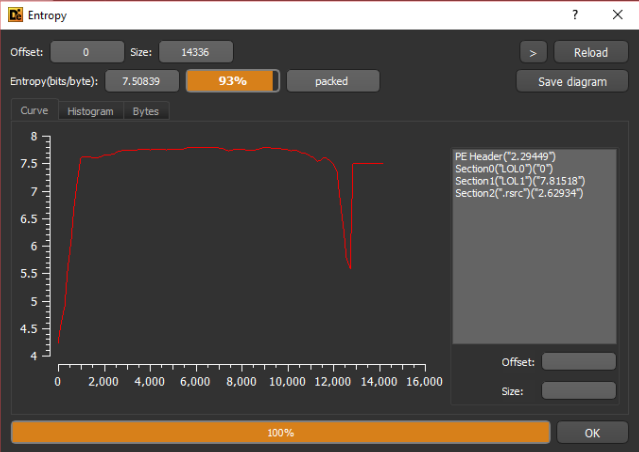
Figure 3: Entropy analysis from Detect It Easy showing an overall score of 7.50 bits/byte at 93% packed. Section LOL1 entropy of 7.81 confirms the primary packed payload. The drop in Section 2 (.rsrc) at 2.63 is consistent with uncompressed resource data.